
FEDERAL FREEZE! Billions in University Funding Frozen
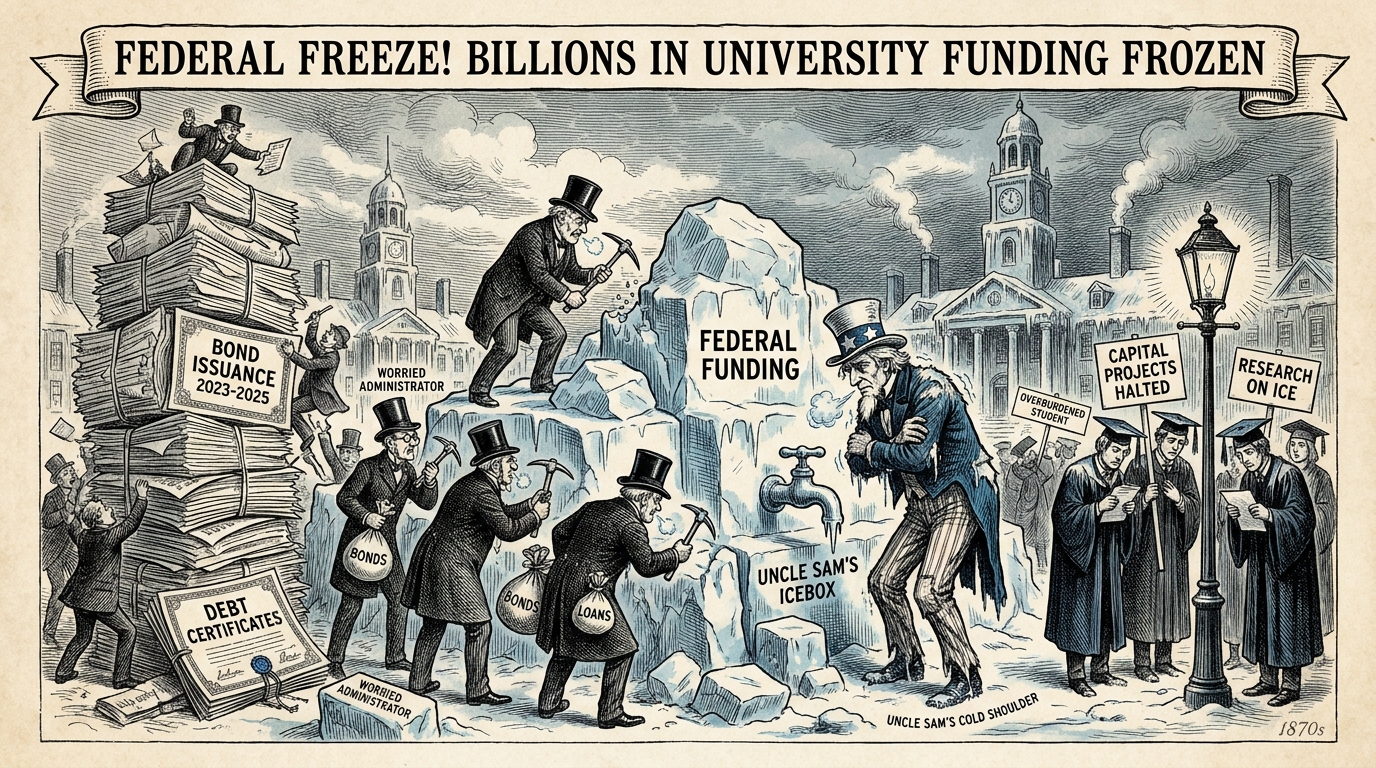
University bond funding faces fresh federal turbulence.
Colleges and Universities Increase Borrowing Amid Federal Funding Uncertainty
Meanwhile, higher education institutions’ financial strategies for funding capital projects, research, and operations have been under increasing scrutiny. A notable acceleration in bond issuance among higher education institutions, from major research universities to smaller colleges, has been primarily driven by growing concerns around the reliability of federal funding.
Surge in Bond Issuance
Between 2023 and 2024, the volume of bonds issued by colleges nearly doubled, according to Bloomberg, and projections indicate a further increase in 2025. The first quarter of 2025 alone witnessed a record $11.6 billion in municipal bond issuance by colleges and universities, reaching a total of $12.4 billion when including taxable bonds, the third-highest quarterly figure ever recorded for the sector. This heightened activity in the higher education bond market underscores the financial adjustments institutions are making in response to evolving circumstances.
This increased dependence on bond financing is due to a number of factors. For some institutions, particularly those facing declining enrollment, borrowing is seen as a means to reinvest in their academic offerings and facilities. As Pat Luby, senior municipal strategist at CreditSights, noted, some schools are “trying to re-tool themselves and change their academic offering” by borrowing funds to create new academic programs and update or construct new facilities. These endeavors are capital-intensive and require a significant timeframe to attract students and become operational.
However, a particularly significant catalyst for the surge in bond issuance in 2025 is the uncertainty and actual reductions in federal funding under the Trump administration. The administration has already halted or threatened to halt federal funding to several universities, including
Smaller Schools and Mid-Tier Universities
Cornell University, Northwestern University, and Columbia University. This has created considerable concern, especially as universities heavily depend on these funds to support their research activities.
The Impact of Federal Actions
Drexel University is one of the 60 institutions of higher education that received a warning letter from the U.S. Department of Education’s Office for Civil Rights (OCR). For a detailed analysis of Drexel University’s financial outlook, including enrollment decline, high debt ratios, and Moody’s credit downgrade, click here to read the full report.
Liz Clark, vice president for policy and research at the National Association of College and University Business Officers, explained that many large universities, such as Harvard University and For example, Princeton University, are issuing more bonds as a financial buffer. These institutions aim to gather the necessary resources to maintain the quality of education and the resources required for scientific research in the face of potential funding shortfalls. Fred Prager, senior managing director at HilltopSecurities, further elaborated on this strategy, stating that “a number of institutions are now financing to get some bridging liquidity so they don’t have to dip too deeply into their reserves until the dust settles”. This allows universities to navigate the period of uncertainty without making drastic cuts to their operations or staffing.
Specific Federal Funding Actions
Notably, the Trump administration’s actions regarding federal funding have been multifaceted:
- Halting and Reviewing Research Funding:
Universities Directly Impacted by the Freeze
Several prominent universities have been directly impacted by the administration’s actions.
Harvard University announced its intention to issue an additional $750 million in bonds just one week after the Trump administration declared a federal review of multi-year research funding connected to the university. This review encompasses $256 million in federal contracts and $8.7 billion in multi-year grant commitments to Harvard. In fiscal year 2024, Harvard received $868 million in federal funding for research, representing 11% of its operating revenues.
- Freezing NIH Grants to Columbia University: The National Institutes of Health (NIH) has taken significant action against Columbia University, initially terminating approximately 400 research grants and subsequently freezing all remaining grant money owed to the university. This decision followed pressure from the White House regarding the university’s handling of anti-Israel protests and allegations of antisemitism. In 2024, Columbia received approximately $690 million in grant funding from the NIH.
- Freezing Funds at Other Universities: The White House also announced the freezing of $1 billion in federal funding at Cornell University and $750 million at Northwestern University. Furthermore, reports indicate that NIH grants to Brown University and Princeton University have also been frozen.
- Increased Scrutiny on Antisemitism and DEI Programs: The Department of Education’s Office for Civil Rights (OCR) has issued letters to 60 universities, including Harvard, Princeton, Columbia, Cornell, and Northwestern, warning them of potential enforcement actions if they fail to adequately protect Jewish students from antisemitic harassment and discrimination under Title VI of the Civil Rights Act. Secretary of Education Linda McMahon expressed deep disappointment that Jewish students continue to fear for their safety on elite U.S. campuses. The administration has also accused some universities of racism through their diversity, equity, and inclusion (DEI) programs.
- Reduction of Indirect Cost Recovery: The federal government has also implemented a reduction in the reimbursement rate for indirect costs associated with research grants, lowering it to 15%. This change is expected to have substantial financial repercussions for universities, even those with significant endowments. Fred Prager described this measure as “taking a machine gun to the sector”.
Moody’s Negative Outlook
The consequences of these federal actions and the resulting financial uncertainty have prompted significant concern within the higher education finance community. Moody’s, a prominent ratings agency, recently lowered its outlook for the higher education sector from stable to negative. This revision reflects concerns about federal funding cutbacks, uncertainty surrounding federal student aid, and the overall economic climate. Moody’s highlighted several key factors contributing to this negative outlook, including the proposed cap on NIH reimbursements for indirect research costs, potential disruptions to federal financial aid programs due to staff reductions at the Department of Education, potential increases in the excise tax on wealthy university endowments, uncertainty over the administration of Title IV financial aid, enforcement actions against DEI initiatives, and risks to international enrollment.
Ryan Henry, a municipal strategist at FHN Financial, pointed out that the impact of these factors is not uniform across all institutions, highlighting a “bifurcation between the haves and the have-nots”. Large research universities with substantial endowments possess considerable resources, making their bonds less risky and allowing them to access credit at lower interest rates. In contrast, smaller universities without such financial cushions may face higher borrowing costs, potentially making bond issuance a less viable or more burdensome option. As Henry explained, the access to credit is available, but “it’s just at a different price,” similar to how individuals with different credit scores face varying loan terms. Consequently, many smaller colleges might determine that the higher borrowing costs associated with issuing bonds are not justifiable.
Strategic Moves by Large Universities
The increased bond issuance by well-resourced universities like Harvard and Princeton can be viewed as a strategic move to secure “bridging liquidity”. This allows them to maintain their operational capacity and research activities while awaiting greater clarity on the future of federal funding. However, the long-term implications of this increased debt burden, even for these wealthy institutions, remain a subject of consideration.
For the broader higher education sector, the current climate presents significant challenges. The combination of potential and actual funding cuts, increased regulatory scrutiny, and economic uncertainty paints a complex and potentially volatile picture. Fred Prager emphasized the unprecedented nature of the current situation, describing it as a “direct assault” on the sector, contrasting it with typical uncertainties like pandemics or wars.
In conclusion, the heightened issuance of bonds by colleges and universities is a direct response to the growing uncertainties surrounding federal funding and increased regulatory pressures under the Trump administration. While larger, well-endowed institutions are leveraging bond markets to create financial buffers and maintain their operations, smaller colleges may face significant hurdles due to higher borrowing costs. The negative outlook for the higher education sector issued by Moody’s underscores the broader financial anxieties within the industry. The evolving relationship between the federal government and universities, marked by funding freezes, reviews, and increased scrutiny, suggests a period of significant financial adaptation and strategic maneuvering within the higher education landscape.
Sources
- Science Magazine. NIH freezes all research grants to Columbia University amid foreign influence investigation. Science.org
- U.S. Department of Education. Office for Civil Rights sends letters to 60 universities under investigation for antisemitic discrimination and harassment. ed.gov
- Forbes / Whitford, Emma. As a result, universities are seeking billions in bonds as protection against Trump’s assault. Forbes
- Marketplace / Brancaccio, David. Colleges turn to bonds as federal research funding faces political pressure. Marketplace
- Inside Higher Ed / Nadworny, Elissa. Moody’s downgrades higher education sector outlook to negative. Inside Higher Ed
- Axios. Federal backlash intensifies against Columbia over protests and foreign funding. Axios
The Daily Northwestern. Federal government freezes $790 million in funding for Northwestern University. Daily Northwestern - Associated Press. Federal funding frozen for Cornell, Northwestern amid investigations. AP News
- The Harvard Crimson. Harvard announces bond sale to brace for potential federal funding challenges. The Crimson
- Morningstar News / Dow Jones. Princeton University to sell $320 million of bonds, warns of risks to federal funding. Morningstar