
Warsh, Forward Guidance, and What the Muni Short End Does Next
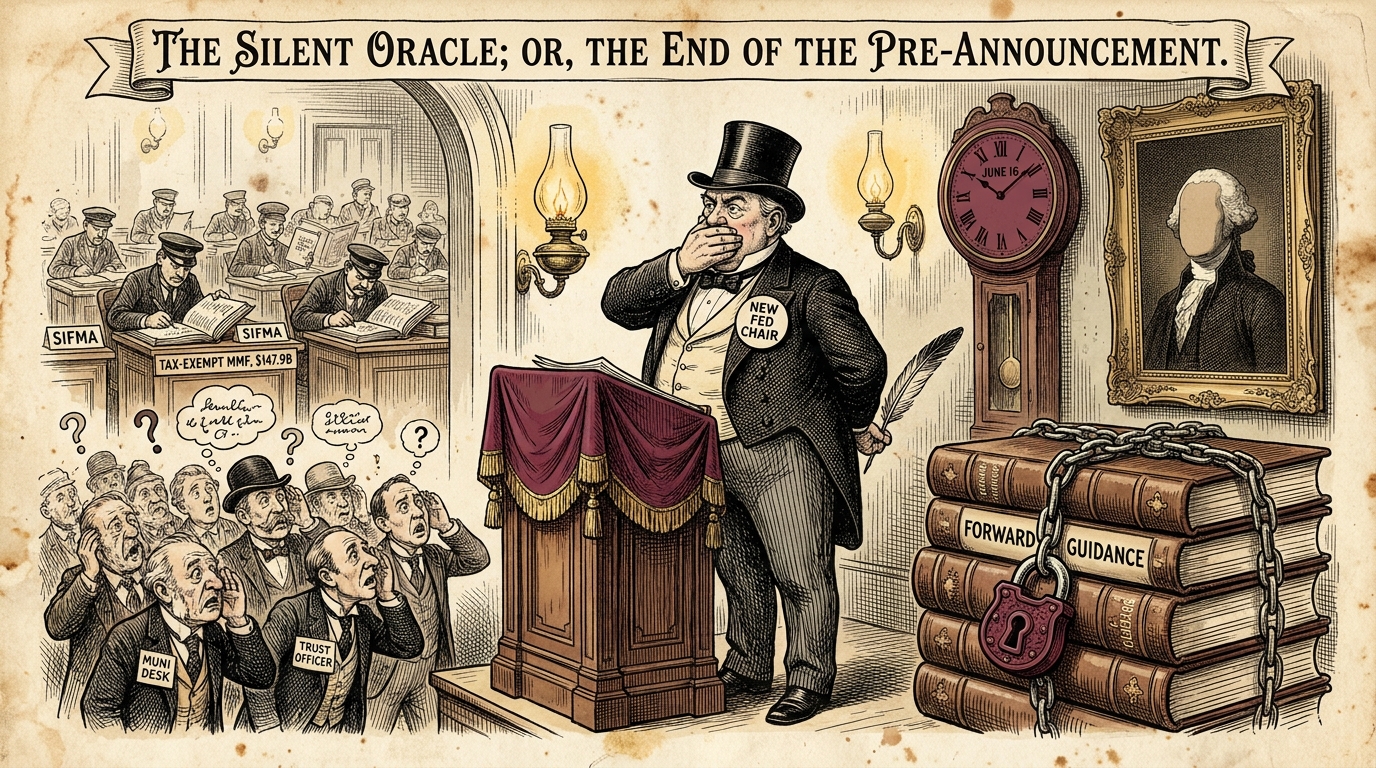
Kevin Warsh cleared a Senate cloture vote 49-44 on May 11, 2026 (Roll Call, May 11 2026). Barring an unusual procedural turn this week, he will be confirmed before Jerome Powell’s term ends on May 15, which puts him in the chair for the June 16-17 FOMC meeting.
This is not a piece about whether Warsh is the right pick. The Senate is handling that. This is a piece about what trust officers and RIA advisors should be looking at in their muni books between now and June 17, given what Warsh has said, on the record and repeatedly, about how he thinks the Fed should communicate.
What Warsh has actually said
Two consistent themes across his speeches, op-eds, and Hoover papers over the past decade. First, he wants the Fed to give less forward guidance, the practice of telling markets in advance what the committee is likely to do. Second, he wants the Fed to target inflation more strictly, with less weight on the dual-mandate balancing act that has shaped policy since 2012.
You can argue with either view. The muni market does not get to. The muni market trades the regime it is given.
Why this matters for the short end
Forward guidance has functioned, for fifteen years, as a kind of verbal duration. When the Fed pre-announces a path, the front end of every curve, including munis, prices off that path. Two-year and three-year SIFMA-linked paper has been remarkably stable because the market knew, roughly, what the next two or three moves would look like.
Take away the pre-announcement and the front end starts trading on data prints. CPI day matters more. PCE day matters more. The morning of the FOMC matters a lot more than the three weeks before it. That is not a forecast; that is what happened the last time the Fed operated without a forward-guidance framework, which was the Greenspan era and the early Bernanke years.
The $147.9 billion question
Tax-exempt money market funds held $147.9 billion in assets as of the most recent ICI weekly report (ICI, May 7 2026). A meaningful share of that is RIA-parked client cash, money that ended up there because the SIFMA index has been printing in a tight range and the alternative, sitting in taxable cash, has been less tax-efficient for high-bracket clients.
SIFMA tracks short Fed expectations. If those expectations get noisier, the index gets noisier. The MMF yields built on top of that index get noisier. None of this breaks anything, tax-exempt MMFs are not credit-risk vehicles, but the smooth quarterly distributions some clients have gotten used to may not stay smooth.
The laddering math
A standard 1-to-10-year muni ladder built in Q1 2026 implicitly assumes the Fed keeps telling you, in advance, when reinvestment rates will shift. Pull that assumption out and the reinvestment risk on a 2027 maturity changes. Not in size, but in timing predictability.
The trust officers I’ve talked to who run heavy 1-to-5-year buckets are already running the question, what does this ladder look like if the next three Fed moves are surprises rather than telegraphed adjustments? It’s a worthwhile exercise. It does not produce a single answer, it produces a range, and the range is wider than it has been in a long time.
What this is not
This is not a call to shorten, lengthen, or restructure anything. Warsh has not chaired a meeting yet. The June dot plot will still reflect the committee Powell built. And the Fed Chair, whoever it is, gets one vote on a committee of twelve.
It is also not a doom note. A Fed that talks less is not a Fed that does worse. The Greenspan-era muni market functioned. Desks adapted. The point is that the adaptation work, for a lot of muni professionals who came up after 2008, has not been done yet, because the regime has not required it.
The practical week
Three things worth doing between now and June 17. Pull up your short-duration bucket and stress-test it against a 25 basis-point surprise in either direction. Look at the SIFMA-linked exposure across client MMF positions and note which clients are most sensitive to distribution variability. And read whatever Warsh says in his first public remarks as Chair, which will arrive faster than people expect.
The muni market does not need to forecast Warsh. It needs to be ready for a Fed that explains itself less. That is a research exercise, not a trading call. Worth doing now, while the calendar still allows.