
YOUR FLORIDA BONDS ARE UNDERWATER, AND MOODY’S JUST PUT IT ON THE MAP
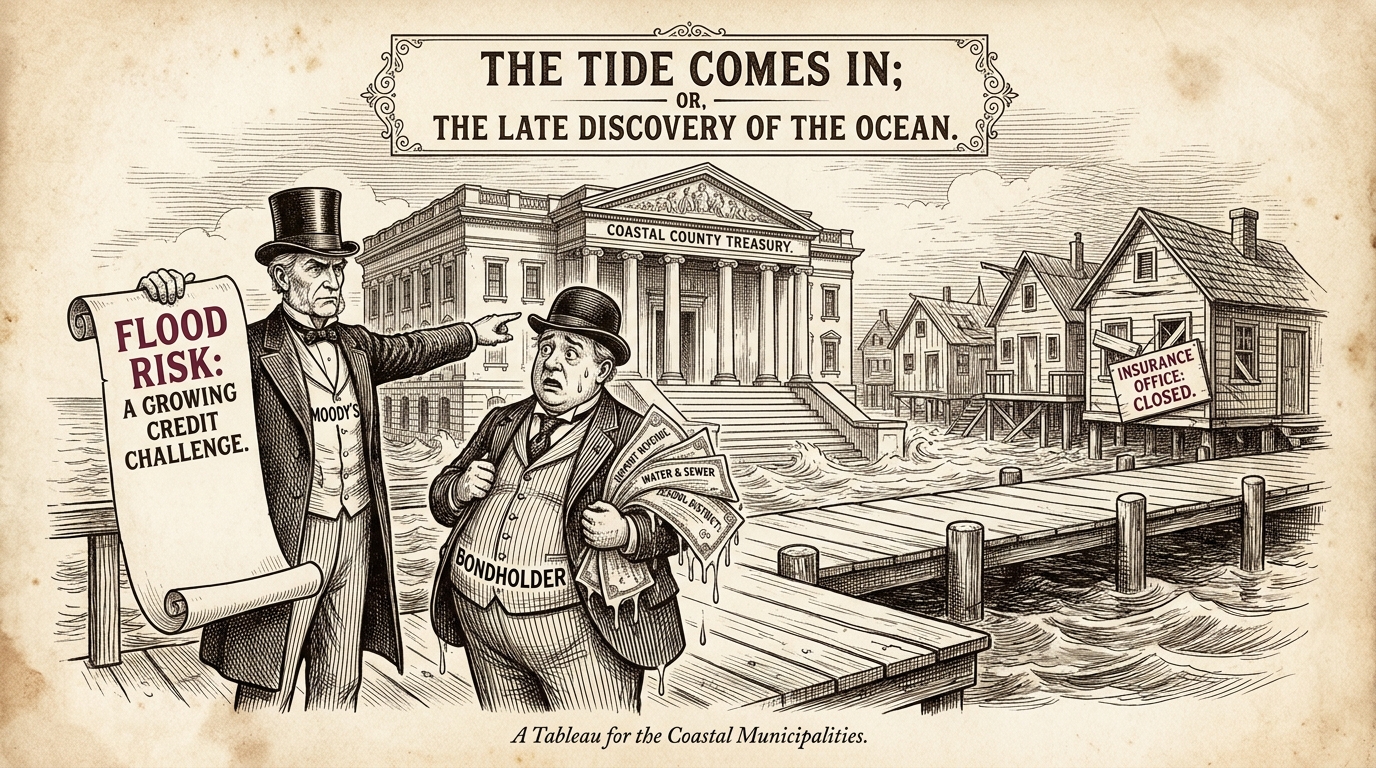
SOAKED. On May 28, Moody’s said it on the record: flood risk is now a growing credit challenge for U.S. state and local governments, with Florida, Louisiana, South Carolina, and Texas coastal counties named on the marquee (Bond Buyer, May 28 2026). The drivers, per Moody’s: more storms, more houses built where storms hit, and an insurance market that is heading for the exits (Bond Buyer, May 28 2026).
That’s the headline. The real question, the one waiting on your desk Monday morning, is simpler and meaner: which bonds in your book are sitting in the puddle?
Moody’s didn’t downgrade anybody. Yet.
Let’s be clear about what happened. Moody’s published a report, not a rating action (Bond Buyer, May 28 2026). Nobody got cut on May 28. What Moody’s did was lay out the backdrop: storms hitting more often, more residential development in flood zones, and carriers pulling out of coastal markets (Bond Buyer, May 28 2026). Florida’s property insurance market has been the public face of this, carriers exiting, carriers going insolvent. The same movie is now playing on the Gulf and the Southeast Atlantic.
The credit chain runs like this. Floods hit the tax base. Insurance pulls back. Buyers vanish. Assessed values bend. Property taxes follow. General obligation debt service is paid from property taxes. Every link in that chain is under more pressure than it was five years ago.
Three kinds of paper, three kinds of trouble
If you own a coastal book, three buckets carry most of the water.
The airports. Miami International. Fort Lauderdale-Hollywood. New Orleans Louis Armstrong. Charleston. Houston Hobby. These runways are at sea level by design. Airport revenue bonds are paid from operations. Operations stop when the runway is a lake. One bad storm and the coverage ratio tells the story.
The utilities. Water, sewer, electric. Lift stations flood. Treatment plants flood. Substations flood. The bonds get paid from rates. The capex to harden the system against more frequent events keeps climbing, and the rate increases needed to pay for that capex meet voters who already got the insurance bill.
The school districts. The sneaky one. School district GOs are paid from property taxes inside the district line. If that line runs through a county where the insurance market is breaking, the assessed value trajectory bends down over the next decade. These bonds don’t default tomorrow. They erode quietly while everyone watches the airports.
Moody’s gave you the map. It didn’t give you the X.
The Moody’s report is a backdrop. It doesn’t tell a PM which of her 800 positions sits in a high-exposure county. Most portfolios aren’t built to answer that question on demand.
The screen we run inside MuniBonds.ai works in three passes. First, geocode every outstanding bond in the book to a county. Second, tag by revenue source: airport, utility, school district GO, hospital, transportation, other. Third, overlay the Moody’s flood exposure categorization plus FEMA flood zone data plus the state insurance market signal. The output is a ranked exposure list with the issuer’s own EMMA disclosure attached, so the analyst can read what the issuer has actually said about resilience capex (EMMA).
The point isn’t a recommendation. It’s a shortlist. Forty names worth reading out of six hundred you’ll never get through.
What the official statements say, and what they leave out
Read enough coastal offering documents and the pattern is obvious. The risk factors section names hurricanes and flooding. The mitigation section walks through seawalls, pump capacity, and federal grants. The financials section almost never models a multi-event scenario inside the coverage ratio.
That’s not a swipe at issuers. The muni regulatory regime doesn’t require climate-scenario disclosure the way corporate filings increasingly do. It does mean the analyst has to run the scenario herself, against the issuer’s audited numbers and the issuer’s own capex plan. The disclosure is the floor, not the ceiling.
The honest part
None of this is a forecast. Coastal munis have been paying debt service through hurricanes for decades. The four states Moody’s named are not at the front of a default queue. What the report describes, and what the screen surfaces, is a slow shift in the credit backdrop that compounds over a long horizon, not a fire next week.
If you own coastal paper, the question this quarter is narrow. Which CUSIPs sit in the four states Moody’s named. What each issuer has actually disclosed about flood resilience. How the insurance market shift in that county is changing the assessed value trajectory under the GOs. That’s the deep-dive assessment MuniBonds.ai runs across the three thousand pages of disclosure per bond, surfaced as a ranked exposure list rather than a binary flag. Worth a look if you have a coastal book and no analyst dedicated to climate exposure.