
The Dog Ate My Bond Rating: How Unrated Bonds Get In Investment Grade Trust Portfolios?
The auditors are not interested in that distinction. Every quarter, the same line appears in the file: why does this account still hold an unrated security? The trust company has to answer it, in writing, for every position, every quarter.
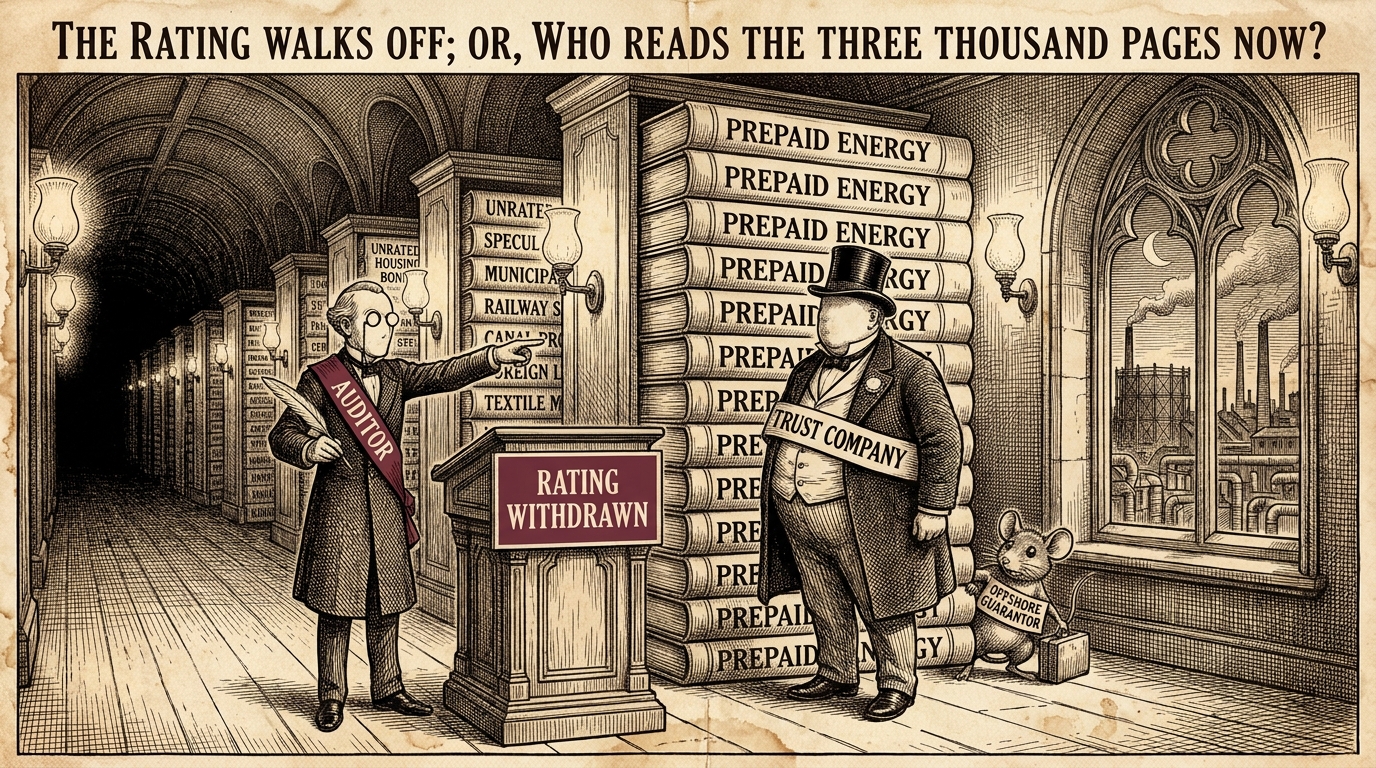
The math that broke the manual approach
The MSRB counted roughly 1.3 million outstanding municipal CUSIPs at year-end 2025 (MSRB 2025 Fact Book). Each bond has its own official statement, continuing disclosure annual filings, material event notices on EMMA, and in many cases supplementary indenture amendments. A reasonable working estimate, used internally by analysts who have actually opened the files, is something on the order of 3,000 pages of disclosure per bond across the life of the deal.
For a 1,000-bond trust portfolio, that is three million pages of documents in the file room. To re-underwrite even the 140 prepaid energy positions on the books, a single analyst would need to read 420,000 pages. Trust desks do not employ teams that can do this. They never did. They outsourced the judgment to the rating agencies, and the rating agencies stopped showing up.
Why the ratings were pulled in the first place
Prepaid energy bonds are a structured municipal product where a nonprofit issuer prepays a gas or electric supplier for a multi-year delivery, funded with tax-exempt debt. The credit quality historically depended on the supplier’s guarantee, often wrapped through a bank or hedge fund vehicle. When the wrap counterparties were repriced or restructured, the rating agencies in several cases withdrew ratings rather than maintain them at a level they could no longer support analytically.
Withdrawal is not a downgrade. A withdrawn rating tells the market the agency is no longer expressing a view, not that the bond went bad. For an experienced credit analyst, that distinction is the whole game. For an auditor working off a checklist, an unrated bond is an unrated bond.
What the analysis actually has to produce
To satisfy the auditor, the trust desk needs a written rationale per CUSIP that addresses: the obligor’s current financial condition, the structural protections in the indenture, the status of any guarantor or counterparty, material events filed on EMMA since the last rating action, and a defensible characterization of where the credit would sit on a ratings scale if a rating were applied today. None of those inputs are exotic. They are all in the documents. The bottleneck is reading 3,000 pages per bond, 140 bonds deep, four times a year.
Where AI fits, and where it does not
Take a look at the specific problem with prepaid energy structures. This is the specific job the AI layer is doing in the muni market right now. It ingests the disclosure, surfaces the material event filings, summarizes the obligor financials, and produces a plain-language investment-grade rationale (or flags the absence of one) that an analyst can review and sign. It is not picking bonds. It is not predicting rate moves. It is doing the document reading that the rating agencies used to do and the trust desk never had the headcount to replicate.
It is also not the endpoint. The pilot still flies the plane. The analyst still owns the credit call, the auditor sign-off, and the conversation with the fiduciary client. The co-pilot reads the manual.
The wider population
Trust companies are the most acute case because the auditor pressure is structural. The same problem sits in community bank held-to-maturity portfolios, in RIA-managed muni ladders for high-net-worth clients with $1M+ in positions, and in any hedge fund holding unrated paper where the limited partners want a current credit narrative. None of these holders are equipped to read 3,000 pages per bond. All of them have to answer for the positions anyway.
It is early days for AI in the muni market. The honest framing is not that the technology replaces a credit analyst. It is that it makes a one-person credit desk capable of covering a 1,000-bond portfolio at a level of detail the desk could not previously sustain. That is a narrow claim. It happens to be the claim that matches what the desks actually need.